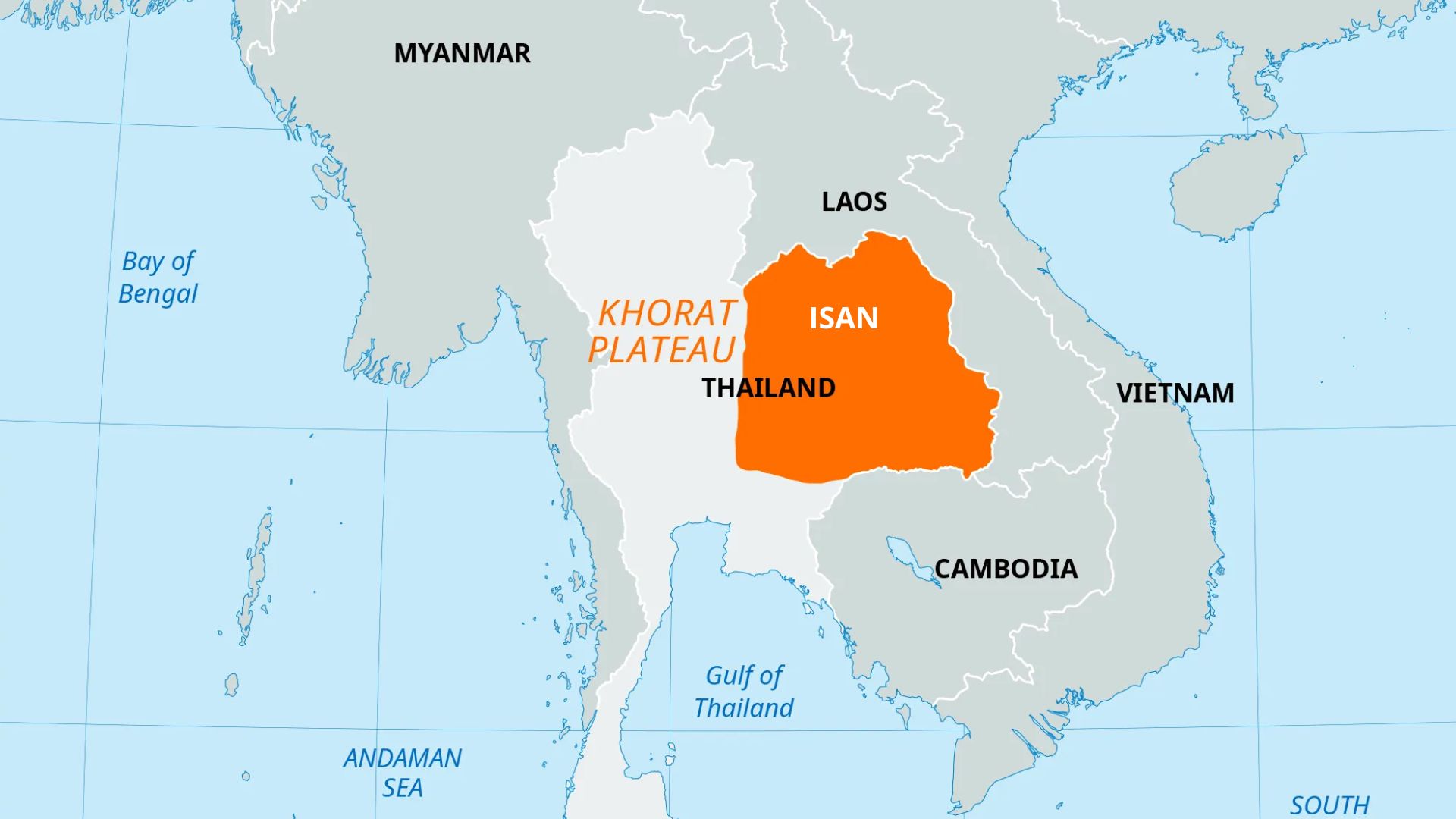

The Lao language in northeast Thailand, known as Isan, is rooted in history, migration, and shared culture. Today, roughly 15 million people speak Isan, compared with under 4 million native Lao speakers in Laos itself.
Explanations vary depending on the historical source, the region, and personal perspective. Isan identity is also not one-size-fits-all. Some people consider themselves Lao, some Thai, and many both.
Which raises the question many people ask: why do Isan people speak Lao? The answer traces back to a few key moments in history
Lan Xang Kingdom
Long before modern borders, the Lao kingdom of Lan Xang spanned both banks of the Mekong, including what is now northeast Thailand. Isan was a crossroads of trade, migration, and shared traditions, with the same language and customs on both sides of the river.
In the 1700s, Lan Xang divided into smaller kingdoms, and Siam (Present day Thailand) gradually took control. This weakened the unity of the Lao world and left the region open to Siamese influence.
Chao Anouvong’s Rebellion
After Chao Anouvong’s rebellion against Siam failed in the late 1820s, Siam forcibly moved huge numbers of Lao people from the east bank of the Mekong to the west. Only about a fifth of the original population is said to have remained on the east bank, while Isan filled up.
Siam Moved People
People were the real wealth. Land was plentiful but workers were scarce, so moving families across the river was like moving wealth into the treasury. It also punished Vientiane, which Siam destroyed almost completely so no rival kingdom could rise near Bangkok. And it kept Vietnam out, leaving less of the east bank for Vietnam to claim.
The 1893 Border
In 1893, France took control of everything east of the Mekong, which became modern Laos. The west bank, with all of its Lao communities, stayed with Siam. A river that had once connected people became a national boundary.
Geography and Population
Isan is a broad, flat plateau that can support a large population, while Laos is mostly mountainous. Laos also lost people to decades of war and to the wave of emigration after 1975, which tipped the balance of Lao speakers toward the Thai side of the river.
Check out this overview on Github: The Isan Language
Language Today
In everyday conversation, Isan and Lao are largely mutually intelligible. Centuries of contact with Central Thailand have added distinctive vocabulary, inflections, and loanwords, giving Isan its own flavor. It’s Lao at its core, shaped by life inside Thailand.
So, Is Isan Lao?
It depends on who you ask. Linguistically and historically, the roots are clearly Lao. Politically, Isan people are Thai citizens, and many proudly identify that way. Others emphasize their Lao heritage, and many embrace both. For most people in Isan, this isn’t a contradiction but a layered identity.
Today, the Isan language remains both a cultural treasure and a challenge. Pressure toward standardization from Central Thailand continues, yet people across the region keep speaking, singing, and passing down their native tongue. History put the language there, and the people kept it alive.
Resources
- Grabowsky, V. (1999). “Forced Resettlement Campaigns in Northern Thailand During the Early Bangkok Period.” Journal of the Siam Society, 87.
- Treaty between France and Siam, 3 October 1893. US Office of the Historian.
- Stuart-Fox, M. (1997). A History of Laos. Cambridge University Press.
- Evans, G. (2002). A Short History of Laos: The Land in Between. Allen & Unwin.
- Ngaosrivathana, M. and Ngaosrivathana, P. (1998). Paths to Conflagration. Cornell Southeast Asia Program.